Cracking JEE Main and JEE Advanced is one of the most demanding academic challenges a Class XI student can take on. With the right two-year roadmap, though, it is entirely achievable alongside your CBSE board preparation. At Tagore Public School, Rewari, our JEE faculty have mentored many students through this journey, and this guide shares the plan that works best.
Understanding the JEE Pathway
JEE is really two examinations. JEE Main, conducted by the National Testing Agency (NTA), is held in two sessions, usually in January and April. It is the gateway to NITs, IIITs and many other engineering colleges. The top performers in JEE Main become eligible for JEE Advanced, which is conducted by one of the IITs and is the only route into the Indian Institutes of Technology.
Board marks still matter. For admission to IITs, NITs and IIITs, students generally need at least 75% in Class XII (65% for SC/ST candidates) or to be in the top 20 percentile of their board. A plan that ignores boards is therefore a risky plan.
Year One (Class XI): Build the Foundation
The first year should focus on concept building. Rushing into difficult problems before the basics of Physics, Chemistry and Mathematics are solid is the single biggest mistake JEE aspirants make. Class XI topics such as mechanics, basic organic chemistry, calculus and coordinate geometry form a large part of the JEE syllabus, and they are the foundation for everything in Class XII.
A practical approach for Class XI
- NCERT first: read every NCERT chapter thoroughly and solve all the in-text and exercise questions. In Chemistry especially, NCERT is directly tested.
- Layer up gradually: once a chapter is clear, move to JEE Main-level problems, and only then to Advanced-level questions.
- Maintain formula and mistake notebooks: a short notebook of formulas and a separate one of mistakes will save weeks of revision time later.
- Test regularly: weekly chapter tests show early which topics need more work.
Year Two (Class XII): Practise, Revise, Simulate
Class XII shifts the balance toward timed practice. Students need to cover the Class XII syllabus, revise Class XI and prepare for boards, all in the same year. That is only possible with a clear plan.
- April to October: complete the Class XII syllabus with JEE-level practice, and revise one Class XI unit every week.
- November to December: full-length JEE Main mock tests every week, with careful analysis of each paper.
- January: JEE Main Session 1, followed by focused board preparation.
- February to March: CBSE board examinations.
- April onwards: JEE Main Session 2 and intensive JEE Advanced preparation for those who qualify.
Subject-Wise Strategy
Physics
Physics rewards understanding over memorisation. Focus on drawing clear diagrams, identifying the concept behind a problem and practising a wide variety of questions. Mechanics and electrodynamics carry significant weight and deserve extra time.
Chemistry
Chemistry is often the highest-scoring subject for well-prepared students. Inorganic chemistry depends heavily on NCERT, organic chemistry on understanding reaction mechanisms, and physical chemistry on regular numerical practice.
Mathematics
Mathematics needs daily practice. Calculus, algebra and coordinate geometry together make up a large share of the paper. Speed and accuracy come only from solving problems every single day.
Balancing Boards and JEE
A well-designed two-year plan does not force students to choose between board results and JEE success. The JEE syllabus overlaps heavily with the CBSE Class XI and XII syllabus, so disciplined preparation for one supports the other. This is exactly why Tagore integrates JEE coaching directly into the regular school timetable instead of treating it as a separate, exhausting add-on that leaves students with no time to rest.
Common Mistakes to Avoid
- Collecting too many reference books instead of finishing a few well.
- Taking mock tests without analysing the mistakes afterwards.
- Neglecting Class XI topics during Class XII.
- Sacrificing sleep and exercise, which reduces concentration and memory.
- Comparing your progress with others instead of your own previous performance.
The Habit That Matters Most
More than any single strategy, consistency wins JEE preparation. A student who studies with steady discipline for two years will almost always outperform one who crams intensely in the final six months. Build a realistic daily schedule, protect it, and trust the process.
How Parents Can Help
Two years of JEE preparation is a long journey for a teenager. Parents help most by keeping the home environment calm, making sure the student eats and sleeps well, and focusing conversations on effort and progress rather than on ranks. Regular contact with teachers gives a clearer picture of how the student is really doing than a single test score.
How Tagore Public School Supports JEE Aspirants
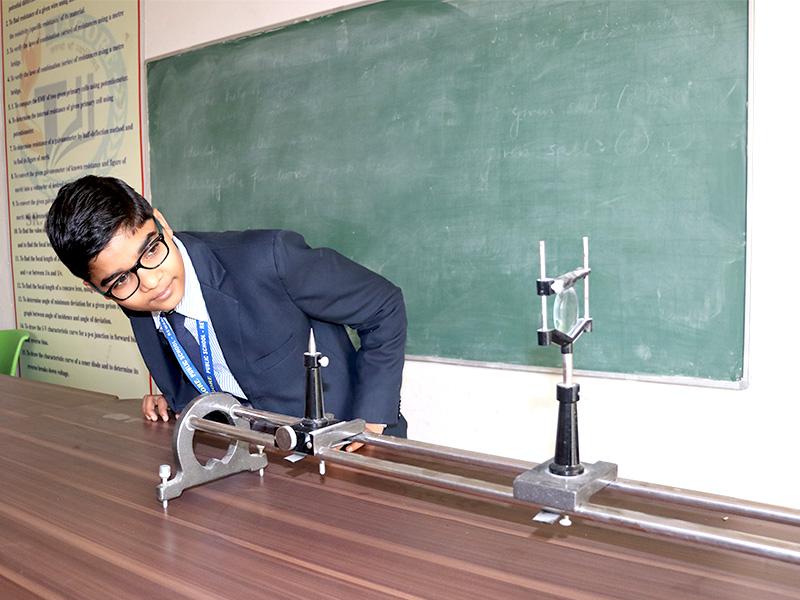
At Tagore Public School, Rewari, JEE preparation is built into the school day. Students benefit from experienced faculty, regular tests, well-equipped Physics and Chemistry laboratories, and a disciplined routine, including for hostel students who study under supervision. Learn more on our JEE page.
Frequently Asked Questions
When should I start preparing for JEE?
The ideal time is the beginning of Class XI, so that you have two full years. Students in Classes IX and X can prepare by strengthening their Mathematics and Science fundamentals.
Is NCERT enough for JEE?
NCERT is essential, especially for Chemistry, but JEE Main and Advanced also require extensive problem-solving practice beyond NCERT.
Can I prepare for JEE and board exams together?
Yes. The syllabi overlap heavily, and a well-planned schedule covers both. Board marks are also required for IIT and NIT admission.
How many mock tests should I take?
Take regular chapter tests in Class XI and at least one full-length mock test a week in the months before JEE Main, analysing every test carefully.